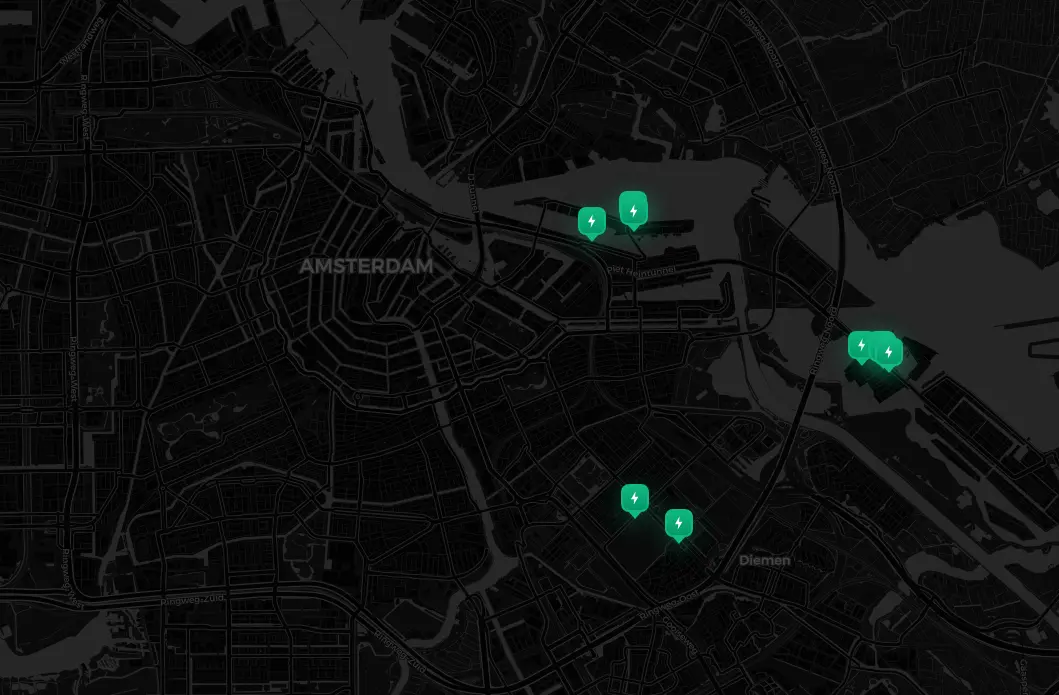
Find E-Bike Charging Stations Worldwide

Charging points for e-bikes and pedelecs, mapped worldwide from open OpenStreetMap data. Free to use — no account, no app.

Map Preview
Map Preview
Map Preview
Scroll

Why do E‑Bike/Pedelec charging stations exist?

Technically, a socket is often enough. Charging stations provide visibility, safety and comfort — and make charging on the go more reliable.

🔒

Safety & Protection

  • Weather‑protected, sometimes lockable compartments
  • Protection against vandalism and theft
  • Sometimes integrated chargers (compatible systems)
⚙️

Convenience & Reliability

  • Multiple outlets/connectors in one place
  • Clear marking: charging allowed and intended
  • Opening hours, precise location, navigation
🔌

Compatibility & Standards

  • Partly standardized systems (e.g., EnergyBus)
  • Information on power, access and usage
  • Extra services (parking, hospitality, tourism)

Plain sockets are shown as well

We clearly label plain sockets — they’re useful but do not offer the benefits of designated charging stations.

Charging stationSocket (no extras)

What this site is

No sign-up, no paywall, no invented numbers.

OpenStreetMap
Where the data comes from
7
Interface languages
Free
No account, no app required
Worldwide
Anywhere OSM has coverage

Charging an e-bike away from home

Charging an e-bike has almost nothing in common with charging a car. Here is what actually matters once you are out on a longer ride.

Where you can actually charge

Public e-bike charging points are rarely dedicated pillars. In practice they are ordinary outdoor sockets that somebody has made available: on a café or restaurant terrace, outside a bike shop, at a tourist information office, in a municipal charging cabinet, or at a guarded bike parking facility. In the Alps and other cycling regions you will also find charging boxes at mountain huts and trailheads.

That is exactly why this map is built on OpenStreetMap. These small, local charging spots are mapped by the people who use them, long before a commercial network would ever list them. If a point exists in OSM and is marked as usable for bicycles, it shows up here.

Which plug you need

The vast majority of e-bike charging points are simply household sockets — Schuko across most of continental Europe, Type E in France and Belgium, BS 1363 in the UK and Ireland. You plug in your own charger, the one that came with the bike. There is no universal e-bike connector, because every drive manufacturer — Bosch, Shimano, Brose, Yamaha, Specialized — uses its own plug on the battery side.

So the single most useful thing you can carry is the charger itself, plus a travel adapter if you are crossing a plug-type border. Car connectors such as Type 2 or CCS cannot charge an e-bike. If a station shows those, it is there for cars — any bike socket will be a separate outlet next to it.

How long a charge takes

A typical e-bike battery holds 400–750 Wh. Standard chargers deliver 2–4 A, which works out to roughly three to five hours from empty to full; a fast charger can halve that. Nobody waits that long mid-ride, and you do not have to.

The useful pattern is topping up. A 45-minute lunch stop on a 4 A charger puts back on the order of 150–200 Wh — often 20 to 40 km of range, depending on assist level, terrain and load. Plan charging around the stops you were going to make anyway, rather than the other way round.

Etiquette and safety

Nearly every charging point on this map belongs to somebody: a business, a municipality, a club. Ask before plugging in wherever there is somebody to ask, buy something if you are charging at a café, and do not leave a battery unattended for hours. Some charging cabinets are locked and the key is at the counter.

Two practical safety points. Do not charge a battery that is still frozen or very hot — let it reach room temperature first, or you will permanently lose capacity. And use only the charger built for your battery. A damaged or swollen battery should not be charged at all, and certainly not in a public place.

What Bike-Charging.com does

Worldwide coverage

Wherever OpenStreetMap has data — from Amsterdam to Tokyo — the same map works.

Open data, no guesswork

Every point comes from OpenStreetMap. We show what is actually tagged there, and say so when something is missing.

Community driven

Found a charging point that is not on the map? Add it to OpenStreetMap and it appears here too.

How it works

Three steps, no account

🔍

Find

Search for a city or use your location, then pan the map. Points load for whatever area you are looking at.

Location or city searchE-bike-only filterWorldwide
📍

Navigate

Tap a point to see what OpenStreetMap knows about it, then open it in your maps app for directions.

Directions in one tapSocket type & feeNo sign-up

Charge

Plug in your own charger. Ask the owner where there is one, and be a good guest.

Bring your chargerMostly household socketsTop up during stops

Frequently asked questions

Straight answers about e-bike charging and about this map

How do I find charging points near me?
Open the map and allow location access, or type a city or address into the search box. The map queries OpenStreetMap for the area you are viewing and shows every point tagged as usable for bicycles.
Do I need an account?
No. There is no registration, no app and no paywall. The map works straight from the browser.
Are the charging points free to use?
Many are, but not all. Where OpenStreetMap records a fee we show it; where it does not, we say 'pricing not specified' rather than guessing. Treat it as a hint and check on site.
Why do some points also serve cars or motorbikes?
Some charging stations offer a bike socket alongside car connectors, and OpenStreetMap marks those as usable for bicycles — so they belong on the map. We label them clearly, and the 'E-bike only' filter hides them if you would rather see dedicated bike points.
Do I have to bring my own charger?
Almost always, yes. Most points are ordinary power sockets, so you plug in the charger that came with your bike. A few bike shops and hotels lend chargers, but do not count on it.
How current is the data?
The map queries OpenStreetMap live every time you pan or zoom, so you always see the current state of the database. What we cannot tell you is whether a socket is free or working right now — that information does not exist in OSM, and we will not invent it.
How long does charging take?
From empty, roughly three to five hours for a typical 500 Wh battery on a standard charger. A 45-minute break usually buys back 20 to 40 km of range, which is what most riders actually need.
A charging point is missing. Can I add it?
Yes, and it is the most useful thing you can do. Add it to OpenStreetMap as amenity=charging_station with bicycle=yes. Once it is in the database it appears on this map automatically — and in every other app that uses OpenStreetMap.

Find your next charging point

Open the map, find a socket, keep riding. Free, no account, in seven languages.